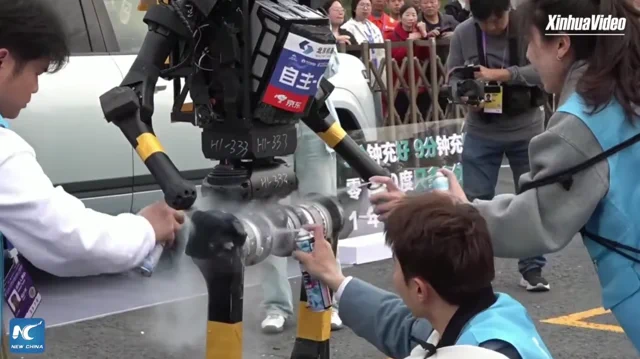
Let’s get one thing straight: a humanoid robot just ran a half-marathon faster than any human being in history. At the 2026 Beijing Humanoid Robot Half-Marathon on 19 April, a machine named “Lightning” (or “Flash”), developed by the smartphone giant Honor, autonomously navigated the 13.1-mile (21.0975km) course in a staggering 50 minutes and 26 seconds. To put that into perspective, it doesn’t just beat the official men’s world record of 57 minutes and 20 seconds—it obliterates it.
This isn’t just a minor step forward; it’s a generational leap that makes last year’s results look like a comedy of errors. The 2025 inaugural race was, to put it mildly, a bit of a shambles. One robot face-planted seconds after the starting gun, another clattered into a fence and shattered, and the crowd favourite—a pint-sized bot called “Little Giant”—literally started smoking. The winner of that particular circus, Tiangong Ultra, clocked in at 2 hours, 40 minutes, and 42 seconds. That was a respectable feat at the time, but it’s pedestrian compared to today’s pace. In just twelve months, we’ve gone from slapstick to superhuman.
A Year of Blistering Progress
So, how did we get here in just 365 days? It’s the result of a brute-force acceleration in both hardware and ambition, bankrolled by China’s aggressive industrial strategy. While Honor’s “Lightning” took the endurance crown, the entire field showed terrifying gains in raw speed. Just days before the race, Unitree Robotics demonstrated its H1 humanoid sprinting at 10.1 metres per second on a track—putting it within spitting distance of Usain Bolt’s peak velocity. This pace, a threefold increase in just two years, proves that physical hardware is finally catching up to the software’s demands.
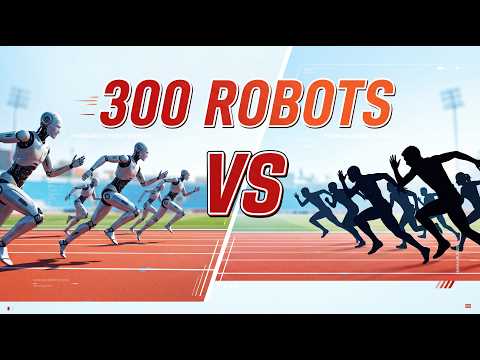
The race organisers also upped the ante for 2026. The number of participants exploded from 20 to over 300 robots from more than 100 teams. Crucially, the focus shifted to autonomy. Nearly 40% of the field competed in the fully autonomous category, where the robot handles every bit of navigation and decision-making on the fly. To drive the point home, any remote-controlled finishers had their times hit with a 1.2x penalty—essentially a “human-in-the-loop” tax. The fact that an autonomous robot won outright is the real headline; this wasn’t just a faster machine, but a significantly smarter one.
More Than a Race, It’s a High-Stakes Audition
This event is far more than a sporting spectacle; it’s a high-stakes commercial audition where the “X Factor” is industrial utility. The grand prize isn’t just a trophy, but over 1 million yuan (roughly £110,000) in industrial orders. Beijing’s E-Town, the tech hub hosting the event, has designed the marathon as a pipeline to turn research projects into viable products. With over 100 robotics firms and a 10 billion yuan government fund backing the area, the message is loud and clear: prove your robot can survive the track, and we’ll give you a contract to run the factory.
To test this, organisers added a new event this year: the “Robot Baturu Challenge.” Held the day before the main race, this saw robots navigating 17 different obstacle courses simulating disaster rescue scenarios—clambering over rubble, scaling stairs, and dealing with real-world chaos. It’s a clear signal that the end goal isn’t just running in a straight line, but creating machines capable of performing complex, dirty, and dangerous tasks in human environments. You can see just how far these humanoids have come in their development in this Humanoid Robots to Run Half-Marathon in Ultimate Endurance Test .
The Technical Edge
This performance leap was built on three pillars of engineering:
- Hardware: Massive upgrades in joint torque, power efficiency, and thermal management. Honor’s winning bot reportedly features a sophisticated liquid-cooling system to stop its motors from melting during the 13-mile sprint.
- Software: Far more robust motion control algorithms allowed for rock-solid stability on everything from tarmac to park paths.
- Navigation: Every robot was kitted out with a BeiDou satellite navigation badge, providing centimetre-level precision—a non-negotiable for high-speed autonomous running.
The Starting Gun on a New Era
It’s easy to get distracted by that 50-minute finish time, but the real story is the rate of change. In a single year, the winning time dropped by nearly two hours. The competition evolved from a novelty act where simply “not falling over” was a win, into a legitimate athletic contest where the victor surpassed the very peak of human achievement.
While there were still a few hiccups—one robot reportedly took a tumble at the start and another clipped a barrier—the overall capability of the field was night and day compared to 2025. The question is no longer if humanoids can handle complex, dynamic physical tasks, but how soon they’ll be doing them in our streets and warehouses. The 2026 Beijing Half-Marathon wasn’t just a race; it was the starting gun for an era where robot physicality is no longer a gimmick, but a world-beating reality. The rest of the world has officially been put on notice.