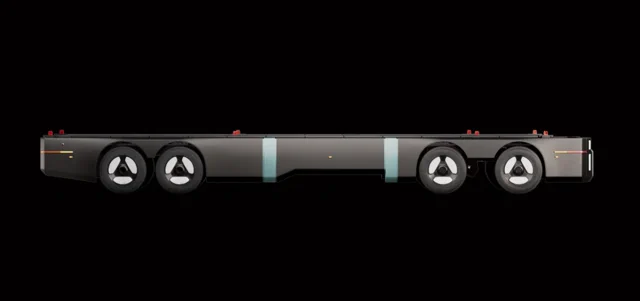
In a landscape littered with billion-dollar behemoths, a newcomer named Humble Robotics is making a debut that is anything but modest. The San Francisco-based startup has stepped out of stealth mode with a $24 million (£19 million) seed round and a vehicle that looks like it has been beamed in from a minimalist future: a fully autonomous, cabless, electric hauler designed to shift freight from dock to dock without a soul behind the wheel. Founded by Eyal Cohen—a veteran of Apple, Uber, and Waabi—the firm is betting that the future of logistics isn’t just about clever software, but a ground-up reimagining of both hardware and AI.
The “Humble Hauler” is a Class 8 platform that looks less like a traditional lorry and more like a sleek, motorised slab. By ditching the driver’s cab entirely, the vehicle is significantly lighter than a standard semi-truck, allowing for a beefier payload and a literal 360-degree field of vision for its sensors. Humble claims its hauler boasts a range of up to 200 miles (roughly 320 km) and a top speed of 55 mph (90 km/h), specifically targeting the “middle mile”—the controlled chaos of warehouses, railyards, and seaports.
Under the bonnet—or whatever passes for one on a cabless slab—is an AI brain powered by Vision-Language-Action (VLA) models. Rather than relying on a traditional robotics stack with its clunky layers of perception, prediction, and planning, Humble’s “physical AI” learns to drive by soaking up real-world data. This allows it to reason through and react to unpredictable situations on the fly. This vision-first philosophy is a sharp pivot from competitors who lean heavily on eye-wateringly expensive LiDAR setups and meticulously pre-mapped environments. While the sensor suite does include cameras, LiDAR, and radar for redundancy, the VLA model is undoubtedly the star of the show.
Why does this matter?
Humble Robotics is charging into a notoriously brutal market, squaring up to established players like Aurora, Waabi, and Kodiak Robotics. Their “full-stack” gamble—building both the hardware and the AI driver from scratch—is a classic high-stakes play. If their VLA-powered brain can truly navigate the messy “edge cases” of logistics, it could dramatically slash the cost and complexity of autonomous freight.
However, the road from a polished website and a seed round to a fleet of battle-hardened, all-weather autonomous trucks is a long and expensive slog. The true test will be whether this “humble” hauler can graduate from the safety of controlled yards to the grit and unpredictability of the global supply chain. For now, it’s a gutsy challenge to the industry status quo, delivered in a very minimalist package.